Comparative Study of Bacterial Culture Isolates and Drug Resistance Patterns Among Elderly Patients with Bacterial Community-Acquired Pneumonia Before and During the COVID-19 Pandemic
DOI:
https://doi.org/10.70172/pjcd.v23i1.11533Keywords:
bacterial pneumonia, COVID-19, antimicrobial resistanceAbstract
Background: The COVID-19 pandemic has changed the microbiological distribution and drug-resistance patterns of pathogens in community-acquired pneumonia (CAP). This study aimed to evaluate these among elderly patients with CAP before and during COVID-19.
Methodology: Data was collected from patients aged 65 to 85 years with a diagnosis of bacterial pneumonia admitted to the Veterans Memorial Medical Center pre-COVID-19 and during COVID-19. The study compared bacterial pathogens, antimicrobial resistance patterns, length of hospital stay, and mortality between the two groups.
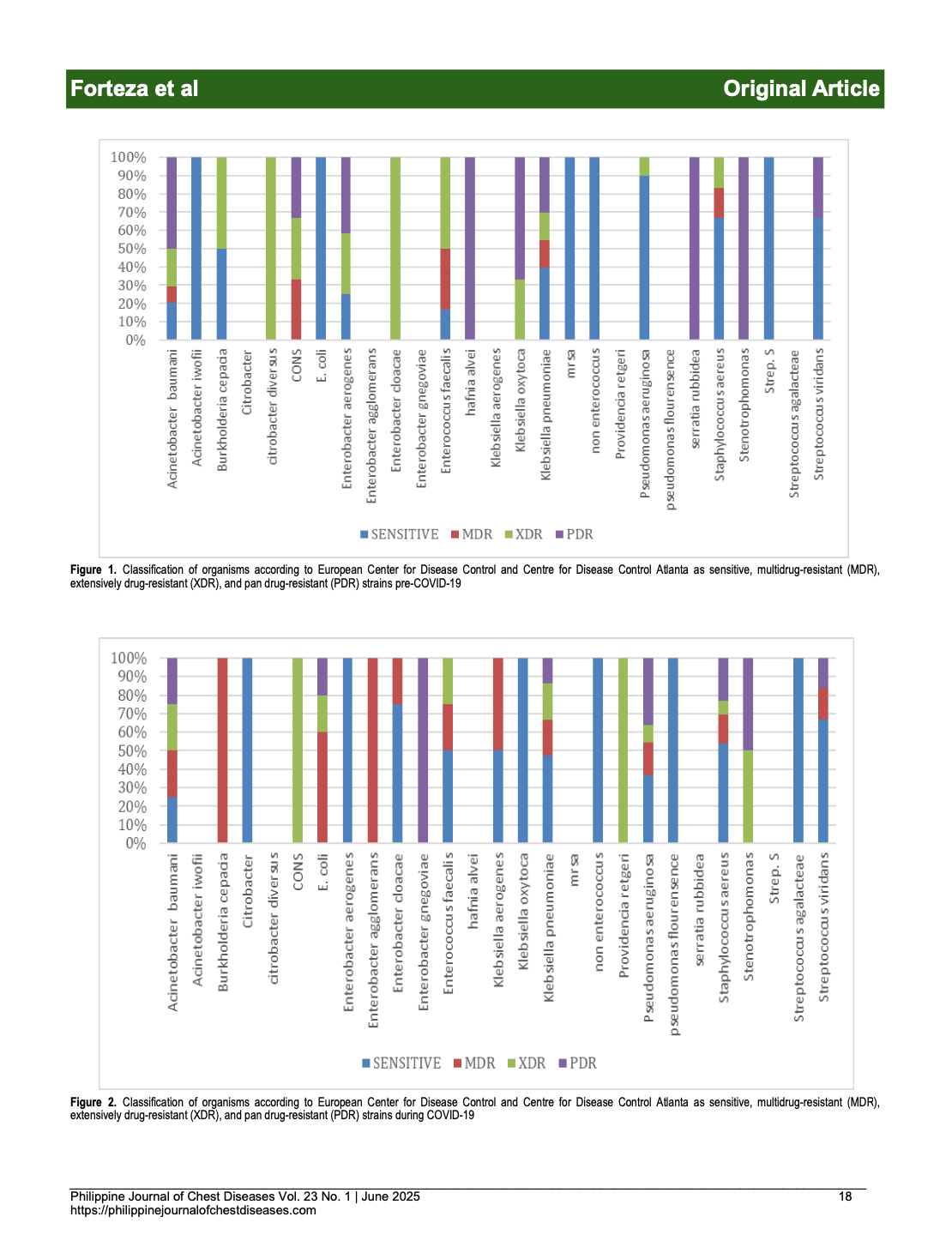
Results: Data from 243 patients was analyzed. The COVID-19 group was younger and had more males compared to the pre-COVID-19 group (median age 70 [IQR 67–75] vs 74 [IQR 67–80] years; p = 0.015 and 74.50% vs 56.45%; p = 0.005, respectively). Hypertension was the most common comorbidity in the pre-COVID-19 group while diabetes was most common in the COVID-19 group. Similar proportions of almost all bacterial pathogens were observed. Among patients without COVID-19 co-infection, antimicrobial resistance was higher in the pre-COVID-19 group but was not significant (61.90% vs 55.56%; p = 0.316). Multidrug-resistant (MDR) pathogens were found to be higher in the COVID-19 group (21.37% vs 9.52%; p = 0.010). The majority of patients in both groups had prolonged hospital stays (~61%). Overall mortality was lower in the COVID-19 group (41.88% vs. 56.35%; p = 0.024) while, for patients with MDR, mortality was higher in the COVID-19 group (24.49% vs 8.45%, p = 0.016).
Conclusion: The distribution of bacterial isolates did not differ significantly between pre-COVID-19 and COVID-19 periods. MDR was higher during the COVID-19 period. For MDR-infected patients, mortality was higher in the COVID-19 group. The findings of this study help inform the antimicrobial stewardship program of the institution. Vigilant surveillance and regular reporting of bacterial pathogens are needed to improve patient outcomes.
References
2016
2. Stupka JE, Mortensen EM, Anzueto A, Restrepo MI. Community-acquired pneumonia in elderly patients. Aging Health. 2009;5(6):763-774. https://doi.org/10.2217/ahe.09.74
3. Bernal, SB, Santiaguel J, Lim-Teodoro A. Prevalence, demographic, clinical characteristics and outcomes of elderly patients with community acquired pneumonia admitted in a tertiary Medical Center: A Retrospective Cohort Study. J Geriatr Med Gerontol. 2021;7:117. https://doi.org/10.23937/2469-5858/1510117
4. Metlay J, Waterer G, Long Ann et al. Diagnosis and treatment of adults with community-acquired pneumonia. Am J Respir Crit Care Med. 2019 Oct;200(7):e45-e67. https://doi.org/10.1164/rccm.201908-1581
5. Philippine Society for Microbiology and Infectious Diseases. Clinical practice guidelines management and prevention of adult community-acquired pneumonia. Accessed May 2023. https://www.psmid.org/wp-content/uploads/2021/12/2020-Community-Acquired-Pneumonia-Clinical-Practice-Guidelines.pdf
6. Asokan G, Ramadhan T, Ahmed E, Sanad H. WHO Global priority pathogens list: A bibliometric analysis of Medline-PubMed for knowledge mobilization to infection prevention and control practices in Bahrain. Oman Med J. 2019;34:184-193. https://doi.org/10.5001/omj.2019.37
7. Tang HJ, Lai CC, Chao CM. Changing epidemiology of respiratory tract infection during COVID-19 pandemic. Antibiotics (Basel). 2022 Feb 25;11(3):315. https://doi.org/10.3390/antibiotics11030315
8. Mutnal MB, Arroliga AC, Walker K, Mohammad A, et al. Early trends for SARS-CoV-2 infection in central and north Texas and impact on other circulating respiratory viruses. J Med Virol. 2020;92:2130–2138. https://doi.org/10.1002/jmv.26010
9. Olsen, SJ, Azziz-Baumgartner E, Budd, AP, et al. Decreased influenza activity during the COVID-19 pandemic—United States, Australia, Chile, and South Africa, 2020. Am J Transplant. 2020 Dec;20(12):3681-3685. https://doi.org/10.1111/ajt.16381
10. Lee L, Butt K, Buckrell S, et al. National influenza mid-season report, 2020–2021. Can Commun Dis Rep. 2021;47:1–4. https://doi.org/10.14745/ccdr.v47i01a01
11. Soo RJJ, Chiew CJ, Ma S, Pung R, Lee V. Decreased influenza incidence under COVID-19 control measures, Singapore. Emerg Infect Dis. 2020;26:1933–1935. https://doi.org/ https://doi.org/10.3201/eid2608.201229
12. Kuo SC, Shih SM, Chien LH, Hsiung CA. Collateral benefit of COVID-19 control measures on influenza activity, Taiwan. Emerg Infect Dis. 2020;26:1928–1930. https://doi.org/10.3201/eid2608.201229
13. Lee H, Lee H, Song KH, Kim ES, et al. Impact of public health interventions on seasonal influenza activity during the COVID-19 outbreak in Korea. Clin Infect Dis. 2021 Jul 1;73(1):e132-e140. https://doi.org/10.1093/cid/ciaa672
14. Li F, Zhang Y, Shi P, Cao L, et al. Epidemiology of viruses causing pediatric community-acquired pneumonia in Shanghai during 2010-2020: What happened before and after the COVID-19 outbreak? Infect Dis Ther. 2022 Feb;11(1):165-174. https://doi.org/10.1007/s40121-021-00548-x
15. Chan K-PF, Ma T-F, Ip MS-M, et al. Invasive pneumococcal disease, pneumococcal pneumonia and all-cause pneumonia in Hong Kong during the COVID-19 pandemic compared with the preceding 5 years: A retrospective observational study. BMJ Open. BMJ Open. 2021;11:e055575. https://doi.org/10.1136/ bmjopen-2021-055575
16. Fujita, J. Mycoplasma pneumoniae pneumonia and respiratory syncytial virus infection in Japan during the severe acute respiratory syndrome coronavirus 2 pandemic. Respir. Investig. 2021 Jan;59(1):5-7. https://doi.org/10.1016/j.resinv.2020.11.002
17. Brueggemann A, Van Rensburg MJ, Shaw D, et al. Changes in the incidence of invasive disease due to Streptococcus pneumoniae, Haemophilus influenzae, and Neisseria meningitidis during the COVID-19 pandemic in 26 countries and territories in the Invasive Respiratory Infection Surveillance Initiative: A prospective analysis of surveillance data. Lancet Digit Health. 2021;3:e360–e370. https://doi.org/10.1016/S2589-7500(21)00077-7
18. Chao CM, Lai CC. Increasing Legionella in Taiwan during COVID-19 pandemic. Am J Infect Control. 2022 Jan 28;50(2):237–238. https://doi.org/10.1016/j.ajic.2021.10.024
19. Clemente I, Santini SJ, Vittorini P, et al. Fall of viral and bacterial pneumonia hospitalizations following COVID-19 pandemic mitigation strategies: A Central Italian Region retrospective study. Intern Emerg Med. 2023;18(4):1181-1189. https://doi.org/10.1007/s11739-023-03213-y.
20. Boral J, Genç Z, Pınarlık F, et al. The association between Acinetobacter baumannii infections and the COVID-19 pandemic in an intensive care unit. Sci Rep. 2022;12(1):20808. https://doi.org/10.1038/s41598-022-25493-8
21. Rangel K, Chagas TPG, De-Simone SG. Acinetobacter baumannii Infections in Times of COVID-19 Pandemic. Pathogens. 2021 Aug 10;10(8):1006. https://doi.org/ 10.3390/pathogens10081006.
22. Chemisova O, Noskov A, Pavlovich N et al. Etiology of Community-Acquired and Hospital-Acquired Pneumonia Associated with COVID-19. Int J Infect Dis. 2022 Feb 28;116:S39. https://doi.org/10.1016/j.ijid.2021.12.093
23. Musuuza JS, Watson L, Parmasad V, Putman-Buehler N et al. Prevalence and outcomes of co-infection and superinfection with SARS-CoV-2 and other pathogens: A systematic review and meta-analysis. PLoS One. 2021;16(5):e0251170. https://doi.org/10.1371/journal.pone.0251170
24. Bassetti M, Magnasco L, Vena A et al. Methicillin-resistant Staphylococcus aureus lung infection in coronavirus disease 2019: How common?. Curr Opin Infect Dis. 2022;35(2):149-162. https://doi.org/10.1097/QCO.0000000000000813.
25. Serigstad S, Markussen DL, Ritz C, et al. The changing spectrum of microbial aetiology of respiratory tract infections in hospitalized patients before and during the COVID-19 pandemic. BMC Infect Dis. 2022;22(1):763. https://doi.org/10.1186/s12879-022-07732-5
26. Erdem I, Ardic E, Turker E, et al. Comparison of antibiotic use in the COVID-19 pandemic with the pre-pandemic period in a university hospital. Arch Med Sci. 2022 Aug 30;18(5):1392-1394. https://doi.org/10.5114/aoms/152752.
27. Hurtado IC, Valencia S, Pinzon EM et al. Antibiotic resistance and consumption before and during the COVID-19 pandemic in Valle del Cauca, Colombia. Rev Panam Salud Publica. 2023 Apr 19;47:e10. https://doi.org/10.26633/RPSP.2023.10.
28. Khaznadar O, Khaznadar F, Petrovic A et al. Antimicrobial Resistance and Antimicrobial Stewardship: Before, during and after the COVID-19 Pandemic. Microbiol Res. 2023 14(2), 727-740. https://doi.org/10.3390/microbiolres14020052
29. Khoshbakht R, Kabiri M, Neshani A, et al. Assessment of antibiotic resistance changes during the Covid-19 pandemic in northeast of Iran during 2020-2022: an epidemiological study. Antimicrob Resist Infect Control. 2022;11(1):121. https://doi.org/10.1186/s13756-022-01159-y
30. Lakbar I, Medam S, Ronflé R et al. Association between mortality and highly antimicrobial-resistant bacteria in intensive care unit-acquired pneumonia. Scientific Reports. 2021 Aug 13;11(1):16497. https://doi.org/10.1038/s41598-021-95852-4
31. Polly M, de Almeida BL, Lennon RP et al. Impact of the COVID-19 pandemic on the incidence of multidrug-resistant bacterial infections in an acute care hospital in Brazil. Am J Infect Control. 2022;50(1):32-38. https://doi.org/10.1016/j.ajic.2021.09.018
32. Rao CM, Rout P, Pattnaik AP et al. The Microbial Profile and Resistance Pattern of Pathogens Isolated From Long COVID Pneumonia Patients and Their Correlation to Clinical Outcome: Our Experience From a Tertiary Care Hospital. Cureus. 2022;14(3):e23644. https://doi.org/10.7759/cureus.23644
Downloads
Published
How to Cite
Issue
Section
License
Copyright (c) 2025 Claire F. Forteza, MD, MPM-HSD, Maryanne Dadulla-Daguinod, MD, Emmylou Adamos, MD

This work is licensed under a Creative Commons Attribution 4.0 International License.