Health-related quality of life and sociodemographic factors as predictors of treatment outcomes in pulmonary tuberculosis patients in a tertiary hospital in Cebu City
DOI:
https://doi.org/10.70172/pjcd.v23i2.13333Keywords:
pulmonary tuberculosis (PTB), health-related quality of life (HRQOL), treatment outcomes, World Health Organization Quality of Life—Brief Version (WHOQOL-BREF)Abstract
Background: Pulmonary tuberculosis (PTB) remains a global health concern affecting millions of lives despite intensified screening and treatment efforts. PTB affects physical health and emotional, environmental, and psychological well-being—collectively influencing a patient’s quality of life. This study examined the relationship between pre-treatment health-related quality of life (HRQOL) and sociodemographic data, and their impact on treatment outcomes, whether completed or not, in PTB patients.
Methodology: This prospective cohort study was conducted at the TB DOTS Center of Chong Hua Hospital. It included patients aged 18 years or older without multidrug-resistant or extrapulmonary PTB and without significant comorbidities affecting HRQOL. Sociodemographic data were collected, and HRQOL was assessed using the World Health Organization QOL—Brief Version (WHOQOL-BREF) questionnaire before the start of treatment.
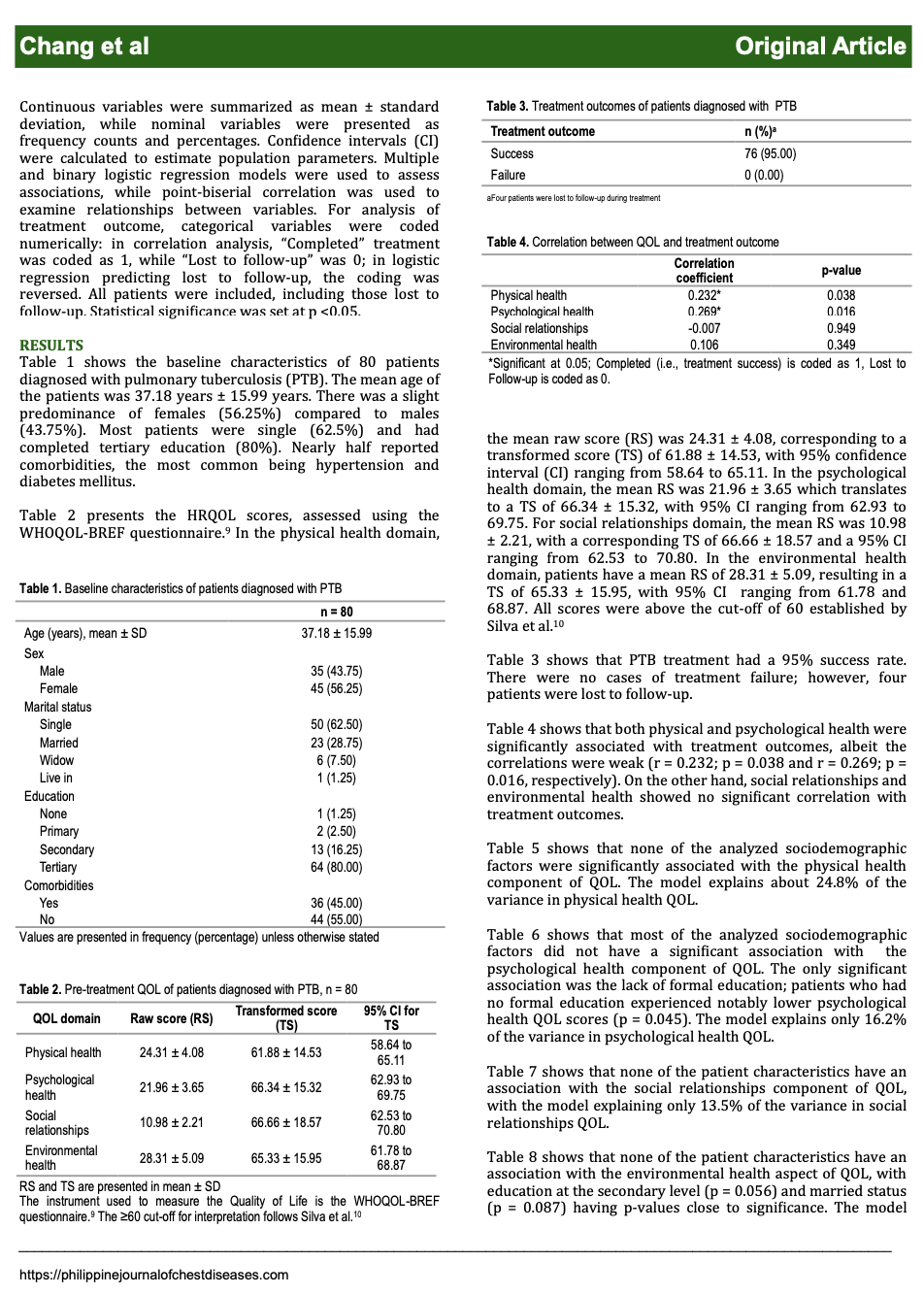
Results: The mean age of our population was 37.18 ± 15.99; 56% were female, 62.5% were single, and 80% completed tertiary education. Fifty-five percent of the participants had comorbidities, the most common of which were hypertension and diabetes mellitus. Before treatment, participants reported a generally acceptable quality of life across all domains (physical, psychological, social, and environmental). Seventy-six patients completed treatment (i.e., treatment success), while four were lost to follow-up. There were no treatment failures. Those who completed treatment showed higher physical and psychological health scores at baseline, albeit the correlation was weak. Sociodemographic factors had minimal association with HRQOL, except for the absence of formal education which was associated with lower psychological scores. None of the analyzed sociodemographic factors were associated with lost to follow-up status.
Conclusion: While PTB treatment is highly effective in achieving clinical success, this study highlights that other factors like QOL are crucial for optimal outcomes. Pre-treatment physical and psychological health are strongly associated with an increased likelihood of treatment completion. The sociodemographic profile had no significant association with HRQOL and treatment outcome.
References
1. Montemayor MT. DOH: 70 Filipinos die daily from tuberculosis. Philippine News Agency. Published March 24, 2023. Accessed November 16, 2024. https://www.pna.gov.ph/articles/1198167
2. Zimmerman E, Smith J, Banay R, Kau M, Garfin AMCG. Behavioural barriers and perceived trade-offs to care-seeking for tuberculosis in the Philippines. Glob Public Health. 2022;17(2):210-222. doi:10.1080/17441692.2020.1855460
3. Macatangay IOD, Liao SASP, Dadural JJA, Gagui FJS, Galas AJA, San Antonio RDFA, Pinlac PAV. Factors associated with treatment outcome of patients with pulmonary tuberculosis in the Philippines, 2015 to 2016. Acta Med Philipp. 2020;54(5):507-515. doi:10.47895/amp.v54i5.2248
4. Namukwaya E, Nakwagala FN, Mulekya F, Mayanja-Kizza H, Mugerwa R. Predictors of treatment failure among pulmonary tuberculosis patients in Mulago hospital, Uganda. Afr Health Sci. 2011;11(Suppl 1):S105-S111. doi:10.4314/ahs.v11i3.70079
5. World Health Organization. WHOQOL: Measuring Quality of Life. Geneva: WHO. Accessed December 23, 2024. https://www.who.int/tools/whoqol
6. Dhuria M, Sharma N, Ingle G. Impact of tuberculosis on the quality of life. Indian J Community Med. 2008;33(1):58-59. doi:10.4103/0970-0218.39249
7. Masumoto S, Yamamoto T, Ohkado A, Yoshimatsu S, Querri AG, Kamiya Y. Factors associated with health-related quality of life among pulmonary tuberculosis patients in Manila, the Philippines. Qual Life Res. 2014;23(5):1523-1533. doi:10.1007/s11136-013-0571-x
8. Department of Health. National Tuberculosis Control Program Manual of Procedures. 6th ed. Manila (PH): Department of Health; 2020. 174 p.
9. World Health Organization. WHOQOL-BREF: Introduction, administration, scoring and generic version of the assessment. Geneva: WHO; 1996. Accessed July 15, 2025. https://www.who.int/publications/i/item/WHOQOL-BREF
10. Silva PA, Soares SM, Santos JF, Silva LB. Cut-off point for WHOQOL-BREF as a measure of quality of life of older adults. Rev Saude Publica. 2014;48(3):390-397. doi:10.1590/s0034-8910.2014048004912
11. Atif M, Sulaiman SAS, Shafie AA, et al. Impact of tuberculosis treatment on health-related quality of life of pulmonary tuberculosis patients: a follow-up study. Health Qual Life Outcomes. 2014;12:19. doi:10.1186/1477-7525-12-19
12. Billah MM, Rahim MA, Biswas SK, et al. Health-related quality of life in patients with pulmonary tuberculosis. Mymensingh Med J. 2023;32(1):103-110.
13. Dujaili JA, Sulaiman SAS, Hassali MA, et al. Health-related quality of life as a predictor of tuberculosis treatment outcomes in Iraq. Int J Infect Dis. 2015;29:4-8. doi:10.1016/j.ijid.2014.12.004
14. Saidi SS, Abdul Manaf R. Effectiveness of family support health education intervention to improve health-related quality of life among pulmonary tuberculosis patients in Melaka, Malaysia. BMC Pulm Med. 2023;23:139. doi:10.1186/s12890-023-02440-5
15. Iqbal MS, Iqbal MW, Bahari MB, Iqbal MZ. Health-related quality of life among tuberculosis patients in Pakistan: a cross-sectional study using WHOQOL-BREF. Value Health. 2014;17(7):A601-A602. doi:10.1016/j.jval.2014.08.2086
16. Sartika I, Insani WN, Abdulah R. Assessment of health-related quality of life among tuberculosis patients in a public primary care facility in Indonesia. J Glob Infect Dis. 2019;11(3):102-106. doi:10.4103/jgid.jgid_136_18
Downloads
Published
How to Cite
Issue
Section
License
Copyright (c) 2026 John Hemingway H. Chang, Laureen Claire Y. Ong

This work is licensed under a Creative Commons Attribution 4.0 International License.