Comparison of baseline pulmonary function, dyspnea severity, and exercise capacity among active TB and TB-negative cases seen in a TB referral clinic
DOI:
https://doi.org/10.70172/pjcd574315419Keywords:
tuberculosis, spirometry, six-minute walk test, mMRCAbstract
Background: Tuberculosis (TB) remains a major health concern in high-burden countries like the Philippines. While post-TB lung disease is well documented, baseline pulmonary function and exercise capacity at the time of TB diagnosis are less studied.
Objective: To compare baseline pulmonary function, dyspnea severity, and exercise capacity between active TB and TB-negative individuals, and to identify factors associated with impairment.
Methods: A cross-sectional study among 290 adults with presumptive pulmonary TB was conducted. After initiating treatment and confirming sputum negativity, participants underwent spirometry, mMRC dyspnea grading, and six-minute walk test. Patients were categorized as active TB or TB-negative. Group comparisons and multivariable regression analyses were performed.
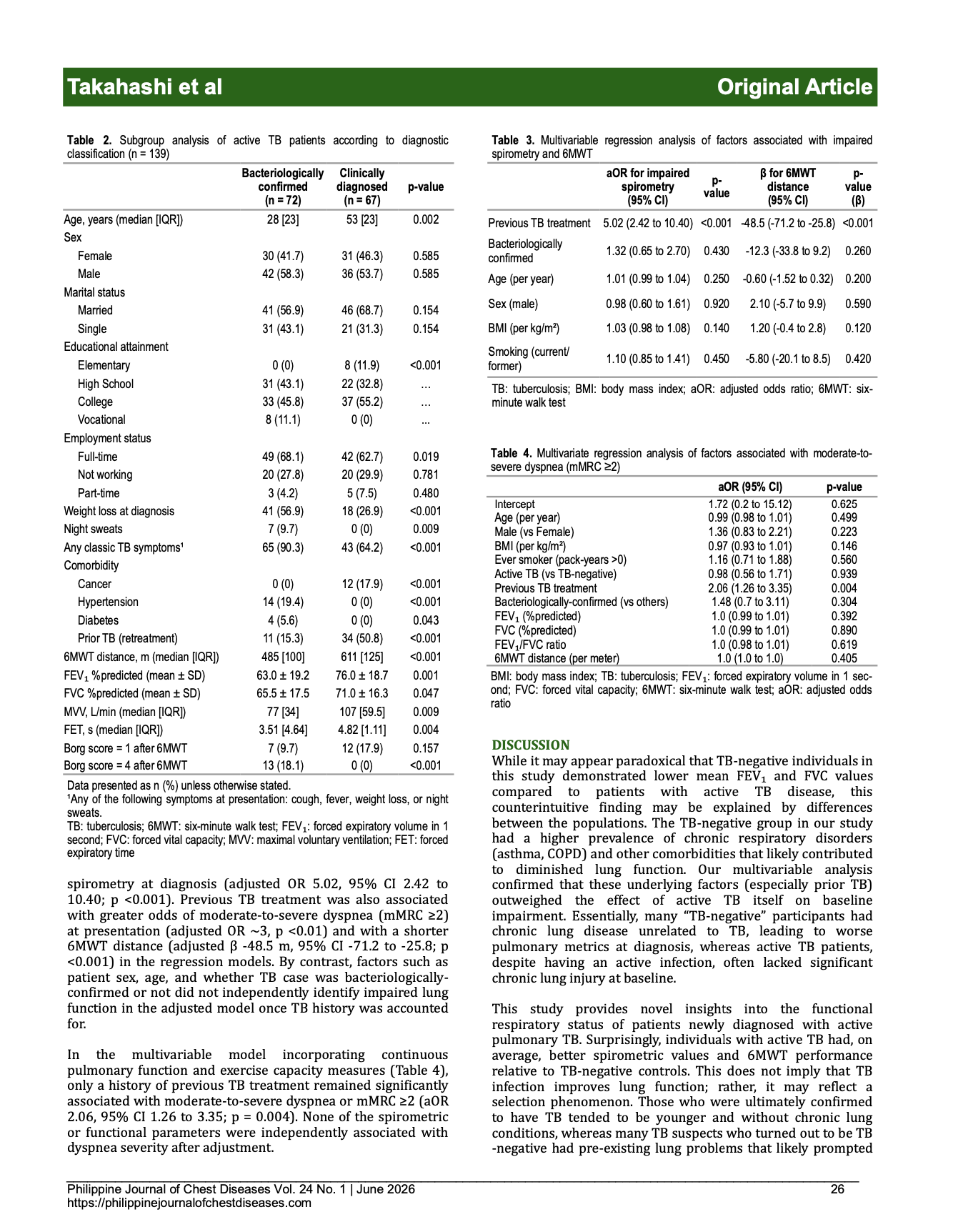
Results: Of 290 participants, 139 had active TB and 151 were TB-negative. Active TB patients were younger and had fewer comorbidities. Nearly one-third of active TB patients had abnormal spirometry at baseline. Compared to TB-negative controls, active TB patients had higher FEV₁ (2.26 ± 0.74 L vs 1.80 ± 0.75 L), FVC (2.97 ± 1.11 L vs. 2.31 ± 0.86 L), and 6MWT distance (539.3 ± 120.5 m vs 488.6 ± 157.3 m) (all p <0.01). Chronic lung diseases were more prevalent among TB-negative individuals. After adjustment, previous TB treatment was the clinical factor most strongly associated with impaired spirometry (aOR 5.02, 95% CI 2.42 to 10.40), moderate-to-severe dyspnea at presentation (aOR 2.06, 95% CI 1.26 to 3.35), and reduced 6MWT distance (β -48.5 m, 95% CI -71.2 to -25.8).
Conclusion: Many patients with active TB exhibit lung impairment even at diagnosis. Nevertheless, active TB patients had surprisingly better lung function in this study which may be attributed to the higher prevalence of asthma and COPD in the TB-negative group. Prior TB treatment is independently associated with spirometric and functional decline. Early pulmonary assessment should be integrated into TB care to inform rehabilitation strategies.
References
1. World Health Organization. Global tuberculosis report 2023. Published November 7, 2023. Accessed March 6, 2025. https://www.who.int/publications/i/item/9789240083851
2. Ratnakumar S, Hayward SE, Denneny EK, et al. TB can have lasting impacts on lung health after cure. European Society of Clinical Microbiology and Infectious Diseases press release. Published April 2024. Accessed March 6, 2025.
3. Ratnakumar S, Hayward SE, Denneny EK, Goldsmith LP, Evans R, Checkley W, et al. Post-pulmonary tuberculosis lung function: a systematic review and meta-analysis. SSRN. Published March 10, 2023. Accessed March 6, 2025. https://doi.org/10.2139/ssrn.4382962
4. Graham BL, Steenbruggen I, Miller MR, et al. Standardization of spirometry 2019 update. An official American Thoracic Society and European Respiratory Society technical statement. Am J Respir Crit Care Med. 2019;200(8):e70-e88. https://doi.org/10.1164/rccm.201908-1590ST
5. ATS Committee on Proficiency Standards for Clinical Pulmonary Function Laboratories. ATS statement: guidelines for the six-minute walk test. Am J Respir Crit Care Med. 2002;166(1):111-117. https://doi.org/10.1164/ajrccm.166.1.at1102
6. Masumoto S, Yamamoto T, Ohkado A, et al. Factors associated with health-related quality of life among pulmonary tuberculosis patients in Manila, the Philippines. Qual Life Res. 2014;23(5):1523-1533. https://doi.org/10.1007/s11136-013-0580-x
7. Allwood BW, van der Zalm MM, Amaral AFS, Byrne A, Datta S, Egere U, et al. Post-tuberculosis lung disease: clinical review and update on management. Lancet Respir Med. 2021;9(8):867-878. https://doi.org/10.1016/S2213-2600(21)00171-8
8. Ratnakumar S, Hayward SE, Denneny EK, et al. Post-tuberculosis lung function: a systematic review and meta-analysis. Eur Respir Rev. 2023;32(168):220221. https://doi.org/10.1183/16000617.0221-2022
9. Pontali E, Silva DR, Marx FM, et al. Breathing back better: a state of the art review on functional evaluation and rehabilitation of post-TB and post-COVID lungs. Arch Bronconeumol. 2022;58(11):754-763. https://doi.org/10.1016/j.arbres.2022.05.010
Downloads
Published
How to Cite
Issue
Section
License
Copyright (c) 2026 Kento Takahashi, MD, Andre Angelo Tanque, MD, Samuel Duran, MD

This work is licensed under a Creative Commons Attribution 4.0 International License.